
August 18, 2026
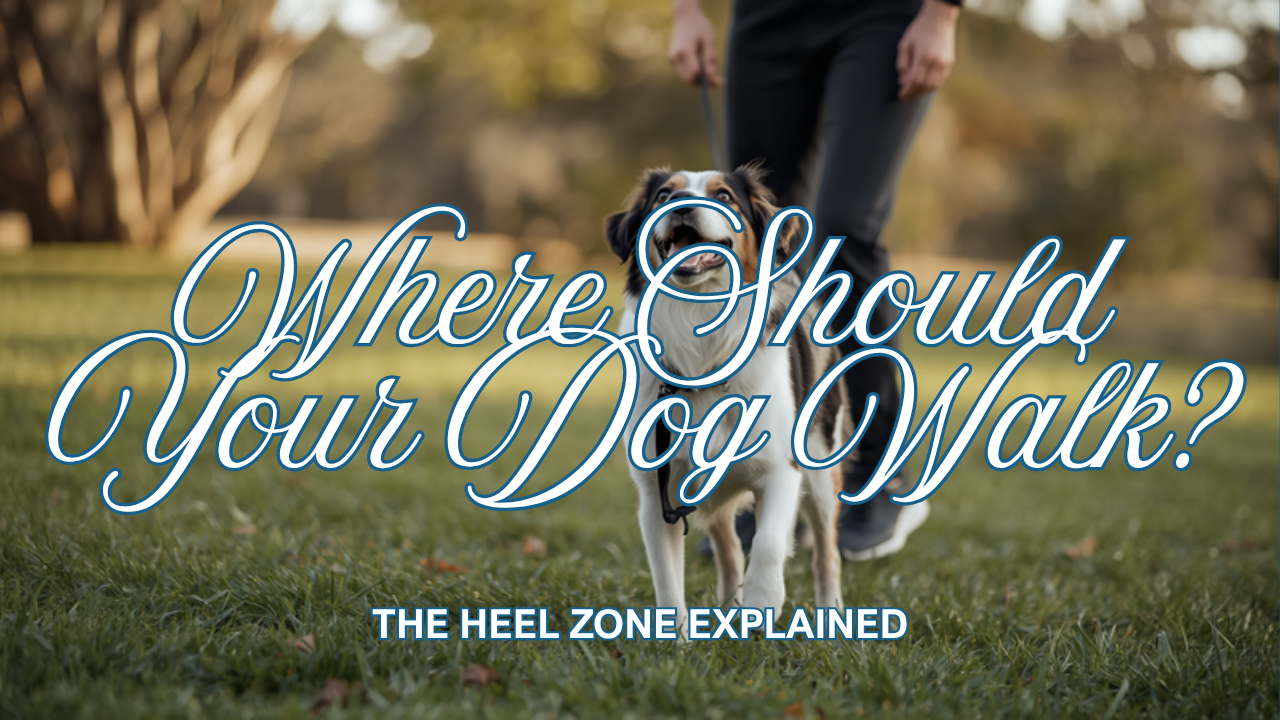
Where Should Your Dog Walk on a Lead? The Heel Zone Explained
Most owners think loose lead walking means their dog glued to their left knee, chin up, competition style. That is obedience trial work. It looks impressive and it is miserable to hold for three kilometres of suburban footpath. Your dog does not need a fixed spot. Your dog needs a zone.
What Is the Heel Zone?
The heel zone is a small box beside you. Picture it running from your knee back to your hip, and about half a metre out to the side. Anywhere in that box is correct.
Your dog can drift forward a bit, drop back a bit, glance around, have a quick sniff. None of that is a problem. The rule is simpler than most people expect: the lead stays slack and your dog's shoulder stays behind your leg. That is the whole boundary.
Why a Zone Beats a Fixed Position
Dogs cannot hold precision for long. Ask for a rigid heel over a full walk and one of two things happens. Either your dog fails and you spend the walk nagging, or your dog succeeds and comes home mentally fried.
A zone gives your dog room to be a dog while you keep the decisions. Who is leading matters far more than how close they are. The moment that shoulder slides past your leg, your dog stops taking information from you and starts taking it from the environment. Now the magpie, the bin chicken and the kelpie across the road are their problem to solve instead of yours.
A zone is also fairer. Clear edges mean your dog can actually tell right from wrong. Vague rules are what create anxious, second-guessing dogs.
How Do You Teach the Heel Zone?
Pick a side and stay on it. Left or right does not matter. Consistency does.
Mark the moment your dog is in the zone, not the moment they leave it. Most owners only speak up when things go wrong, so the dog hears feedback purely as criticism. Say your marker word the second the lead goes slack beside you, then keep walking.
When the shoulder crosses your leg, turn away from your dog and keep moving. No yanking, no yelling. The turn puts them back behind you, and they learn the edge of the zone from what happens when they lose it, not from your voice.
What to Try Today
Walk 20 metres of footpath. Just 20. Every time your dog's shoulder crosses your leg, turn 180 degrees and walk the other way. Mark and praise the first two seconds they land back in the zone.
You will probably cover that same 20 metres ten times over. That is the exercise, not a failure of it. Short repetitions on boring ground beat a long walk of frustration every time.
If your walks feel more like a wrestle, or your dog's pulling is tangled up with reactivity, that is worth a proper set of eyes on it. Walkys runs 1:1 sessions and group programs for exactly this. Have a look at walkys.com.au and let's get your walks back.