


Confidence in public spaces should not feel unpredictable.
For many people exploring an assistance dog, the goal is simple.
Move through daily life with clarity.
Trust that your dog is steady, prepared, and reliable.
Know that progression is guided, not guessed.
That level of confidence does not happen by accident.
It is built through structure.
The Walkys Assistance Dog Development Program is a defined 12-month pathway guiding both handler and dog from suitability assessment through to public access readiness.
This is not casual training.
It is staged development with measurable benchmarks.
Progression occurs only when standards are met.
Because when independence, access, and safety are involved, clarity matters.
Most people come here because life has started requiring strategy. For some, that means mobility is less reliable. For others, it’s psychiatric stability, overwhelm, shutdown, or recovery time. For many, it’s a parent building future independence for their child. This pathway exists to rebuild real-world consistency, not just training progress.
How it Works
A Defined 12-Month Development Model

What You Receive
Throughout the program, you receive:
• Weekly 1:1 coaching
• A structured 12-month roadmap
• Clear behavioural benchmarks
• Task progression tracking
• Public access standards checklist
• Video submission and review
• Written homework plans
• Access to the Walkys Professional Development Platform
• Ongoing accountability
We do not guarantee outcomes without compliance.
We do guarantee clarity, structure, and professional oversight.

This Program Is For You If
• You are serious about developing a legitimate assistance dog
• You are prepared to train consistently each week
• You value standards over shortcuts
• You want a defined pathway rather than trial and error
It is not for casual training.
It is not for rushed outcomes.
It is not for bypassing structure.
The outcome matters too much for that.

When It Matters This Much, Guesswork Is Not Enough
Many owner-trained assistance dogs struggle for one simple reason: there was no defined pathway.
Sessions were booked when problems appeared.
Tasks were layered before foundations were stable.
Public access exposure happened before neutrality was solid.
The result is often frustration, inconsistency, and in some cases, failure at public access level.
For someone relying on an assistance dog, inconsistency isn’t just frustrating. It’s the difference between participating in life and staying home.
This program exists to replace uncertainty with clarity.
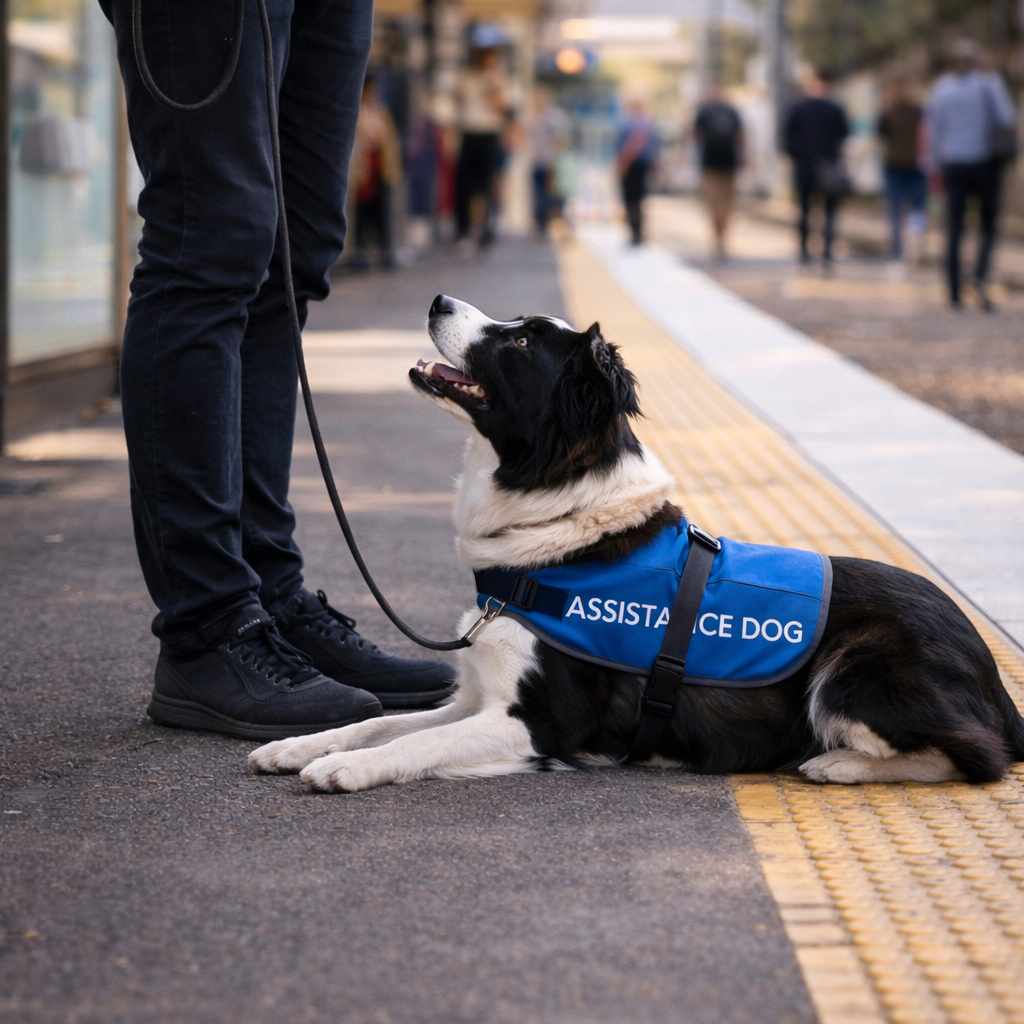
What happens after you apply?
We review your application within 48 hours.
If it looks like there’s potential alignment, we invite you to book an Initial Consultation.
The Initial Consultation is $229 and can be completed in person or via Zoom.
There are no further payments or commitments unless you are assessed as suitable to proceed. We do not book any ongoing training or begin any stage of the program until the Initial Consultation has been completed and we clearly understand your position, goals, and circumstances.
During this consultation, you’ll receive a clear recommendation:
Proceed, Delay, or Redirect.
If suitable, we map out your Stage 1 starting point.
If not suitable yet, you’ll still leave with clarity on what needs to happen next and whether this pathway is right for you.

Limited Intake
Due to the level of oversight required, Walkys accepts a limited number of assistance development clients each year.
All applicants complete:
• Initial consultation
• Suitability evaluation
• Program readiness discussion
If standards are not met, progression does not begin.
That is not exclusion. It is protection.
Delivery Options
What this investment buys isn’t just training.
It buys confidence, clarity, and peace of mind that your dog can be a reliable partner in life.
criteria snapshot
To be considered, you’ll need:
- A diagnosed disability
- A dog that meets basic suitability markers (or you’re open to guidance on sourcing)
- Capacity to train consistently each week
- Commitment to a 12 month pathway
Walkys Assistance Dog Development – Remote
All coaching delivered online.
Mandatory in-person assessments:
Suitability Test and Public Access Test.
Investment
$1,350 per month
12-month commitment
Total $16,200
Assessments via Video Call Included.
If Walkys Trainers travels for assessments:
$1,000 per assessment
Plus flights and accommodation at cost.
Walkys Assistance Dog Development – Elite
(Client attends Walkys)
Weekly coaching plus Monthly in-person sessions at Walkys facilities.
Investment
$1,650 per month
12-month commitment
Total $19,800
Client covers travel and accommodation if required.
Walkys Assistance DOG Development – Executive On-Site
Private development delivered in your environment with weekly coaching and Monthly in-person sessions conducted directly with you.
Investment
$3,000 per month
12-month commitment
Total $36,000
Flights and accommodation billed at cost where required.
Begin the Suitability Process
If you are ready to approach assistance dog development with structure, clarity, and professional guidance, the first step is application.
High standards produce reliable outcomes.
(* Required)
Assistance Dog Training Australia | Walkys NDIS Program
Walkys Assistance Dog Development Program
Australia's owner-trained, NDIS-approved assistance dog development program. Delivered remotely Australia-wide with in-person Public Access Test assessment.
One pathway. Anywhere in Australia.
Walkys runs a complete owner-trained assistance dog development program from initial assessment through Public Access Test (PAT) certification and ongoing annual reassessment. The training is delivered primarily online, with Nath Morrison working directly with handlers across every state. In-person assessment days happen at our Illawarra academy in NSW, with travel coordination support for interstate clients.
If you live in Sydney, Melbourne, Brisbane, Perth, Adelaide, Canberra, Hobart, Darwin, or anywhere regional, this page is your starting point. Geography is not the bottleneck.
Who this program is for
We work with Australians training their own dog to become a certified assistance dog. This is owner-trained assistance dog work, not the placement of a fully-trained dog from a charity's existing pool.
Clients we commonly work with:
- People with psychiatric conditions: PTSD, complex trauma, anxiety disorders, panic disorder, depression where an assistance dog meaningfully supports daily functioning.
- People on the autism spectrum needing sensory regulation, safety tethering, or social bridging support.
- People with mobility impairments requiring task-specific assistance.
- People with hearing impairment, seizure disorders, diabetes, or other recognised disabilities where an assistance dog can be a clinically appropriate support.
You typically have, or are working toward, an NDIS plan where an assistance dog is identified as reasonable and necessary support.
The five-step pathway
Step 1: Initial Consultation (60 minutes, online via Zoom or in-person at our NSW facility). We assess your dog's temperament, your current situation, your support needs, and whether a Walkys-led assistance dog pathway is realistic for your specific dog. Honest assessment. We don't take on dogs we don't believe can pass PAT.
Step 2: Suitability Test. A formal assessment of whether your dog is ready to progress to public access training. Your dog needs to demonstrate the right baseline temperament, body language, and obedience before we invest in the long pathway.
Step 3: Private Training Sessions. The bulk of the training. Building the core skills your dog needs to progress toward assistance certification: settle work, public composure, task-specific behaviours, handler partnership skills. Delivered online with video review, with optional academy days in NSW for hands-on coaching.
Step 4: Public Training Sessions. Taking the dog's skills into real-world public environments. Public access etiquette, exposure to crowds and noise, transport, cafes, shops. Coached remotely; practised wherever you live in Australia.
Step 5: Public Access Test (PAT). The final certification step. A practical, in-person test that assesses your dog's reliability across public environments. Held at our NSW academy or, where appropriate, coordinated with assessors in your state.
Ongoing: Annual Reassessment. Required to maintain your assistance dog's public access certification. Ensures the dog continues to meet the standards.
NDIS funding for assistance dog work
Walkys is an NDIS-approved provider. Assistance dog training services can be funded through your NDIS plan when an assistance dog is identified as reasonable and necessary support.
What's typically claimable:
- Initial Consultation and Suitability Test (assessment and planning)
- Private and Public Training Sessions (skill building toward certification)
- Public Access Test fees
- Annual Reassessment
What's typically not claimable:
- The purchase price of the dog itself
- Ongoing veterinary, food, and grooming costs
- Equipment beyond what's directly required for training
We support NDIA-managed, plan-managed, and self-managed funding arrangements, and we provide the documentation your support coordinator needs. For a detailed walkthrough of how the funding works, see our NDIS Assistance Dog Australia funding guide.
What you'll need on your end
Owner-trained assistance dog work is a multi-year commitment. Realistic expectations:
- Timeline. From the right puppy at 8 weeks to PAT-certified adult: 18 to 24 months. From a suitable adult dog: 9 to 15 months.
- Time commitment. Roughly 5 to 10 hours per week of structured training and exposure work, plus the daily handling of living with your dog.
- Emotional commitment. Public access training is demanding for both the handler and the dog. You will have hard weeks. You will need a treating clinical team in place if your underlying condition is significant.
- Financial commitment. Even with full NDIS funding for training, you remain responsible for the dog's daily costs (food, vet, equipment, insurance).
We do not work with dogs whose temperament is unlikely to meet the assistance dog standard. We will tell you this honestly in the Initial Consultation. It's the kindest thing we can do.
Honest realities: when Walkys isn't the right fit
Owner-trained is one pathway. It isn't the right one for everyone. We will refer you elsewhere if any of these apply:
- You need a fully-trained dog placed with you now. Try Assistance Dogs Australia, MindDog, or Lions Hearing Dogs depending on your condition. Their waitlists are long but the dog arrives ready.
- Your disability requires highly specialised task training (e.g. complex mobility tasks for high spinal injury) outside our experience. We'll point you to specialist providers.
- You're in acute clinical crisis. A multi-year owner-trained program isn't the right starting point when you're in crisis. We'll help you find shorter-term support and revisit assistance dog work when you're more stable.
- You don't have a treating clinical team in place. Owner-trained assistance dog work requires coordination with your psychologist, psychiatrist, GP, or OT. Without that team, the foundations aren't there yet.
Trust signals and credentials
- NDIS-approved provider (provider number available on request and on our NDIS Commission listing)
- Founder and head trainer: Nath Morrison, a decade of experience training dogs across Australia
- 100+ five-star Google reviews from real Illawarra and Australian families
- Two physical academies in NSW (Lake Illawarra and Unanderra) for in-person work
- Press recognition in Illawarra Mercury and other outlets; see our Press & Recognition page
- Three published guides by Nath: Mastering Calm, The Fulfilment Formula, Loose Leash Legends
State-specific information
For state and city-specific details on access laws, certification recognition, and how we deliver to your area:
- Assistance Dog Training in Sydney & NSW
- Assistance Dog Training in Melbourne & Victoria
- Assistance Dog Training in Brisbane & Queensland
- Assistance Dog Training in Perth & WA
- Assistance Dog Training in Adelaide & SA
Condition-specific pages
Funding and process resources
Frequently asked questions
How do I know if my dog can be an assistance dog?
Suitability comes down to temperament, drive, health, and trainability. We assess this in the Initial Consultation and Suitability Test. Not every dog is a fit; we will tell you honestly within the first 90 minutes.
How long does the training take from puppy to certified?
From a suitable puppy at 8 weeks to a PAT-certified adult: 18 to 24 months. From a suitable adult dog with a head start: 9 to 15 months.
How much does an assistance dog cost in Australia?
Owner-trained through Walkys, the program cost across the full pathway typically falls between $8,000 and $15,000 over 12 to 24 months. Most of this can be funded through an NDIS plan.
Can NDIS fund the whole pathway?
NDIS typically funds Initial Consultation, Suitability Test, Private and Public Training Sessions, Public Access Test fees, and Annual Reassessment. NDIS does not typically cover the dog itself, ongoing vet, food, or grooming.
What conditions qualify for an assistance dog?
Conditions vary; common ones include PTSD, complex trauma, anxiety, autism, mobility impairments, hearing impairments, seizure disorders, and diabetes. Each case is assessed with your treating clinician.
Can I train a rescue dog as an assistance dog?
Sometimes. Rescues can become wonderful assistance dogs if temperament and history fit. Many do not. We assess each dog honestly in the Initial Consultation.
What if my dog fails the Public Access Test?
Most dogs that fail can be retrained on the area of weakness and re-tested within 3 to 6 months. Some dogs are not suited to public access work, in which case we'll be honest and help you find the right path for your dog.
Do I have to come to Wollongong for the whole program?
No. Most of the program is delivered remotely via online consultation. PAT is in-person, either at our NSW academy or with state-aligned assessors closer to you.
Can Walkys work with my treating clinician?
Yes. Where appropriate, we work in partnership with your psychologist, psychiatrist, GP, OT, or other treating professionals.
What is the difference between an assistance dog and an emotional support animal?
An assistance dog is trained to perform specific tasks that mitigate the impact of a disability and has public access rights under the Disability Discrimination Act 1992. An emotional support animal provides comfort but is not task-trained and does not have the same legal access.
How is Walkys different from Assistance Dogs Australia or MindDog?
Most major Australian assistance dog charities place fully-trained dogs after a multi-year waitlist. Walkys is owner-trained: we train you and your existing or chosen dog together over 12 to 24 months. Both pathways have a place; we'll tell you honestly which fits your situation.
How do I start?
Book the Initial Consultation below. 60 minutes, online or in-person. We assess your situation and tell you honestly whether the Walkys pathway is right for you.
About the trainer
Nath Morrison is the founder and head trainer at Walkys, with a decade of work training dogs across Australia. The assistance dog pathway is built on The Walkys Method: clarity, calm, fulfilment, applied to the specific demands of public access work. Read his story on Our Story.
For media enquiries or expert commentary on owner-trained assistance dogs in Australia, see our Press & Recognition page.
How to start
The first step is the Initial Consultation. 60 minutes, online via Zoom or in-person at our NSW academy. We'll talk about your situation, your dog (or your plans to source one), and tell you honestly whether this is a realistic pathway for you. No obligation, no upsell.
Book your Initial Consultation →
If you're in mental health crisis, please reach out to Lifeline on 13 11 14, Beyond Blue on 1300 22 4636, or Open Arms (Veterans & Families Counselling) on 1800 011 046. An assistance dog program is a long-term support and not a substitute for crisis care.